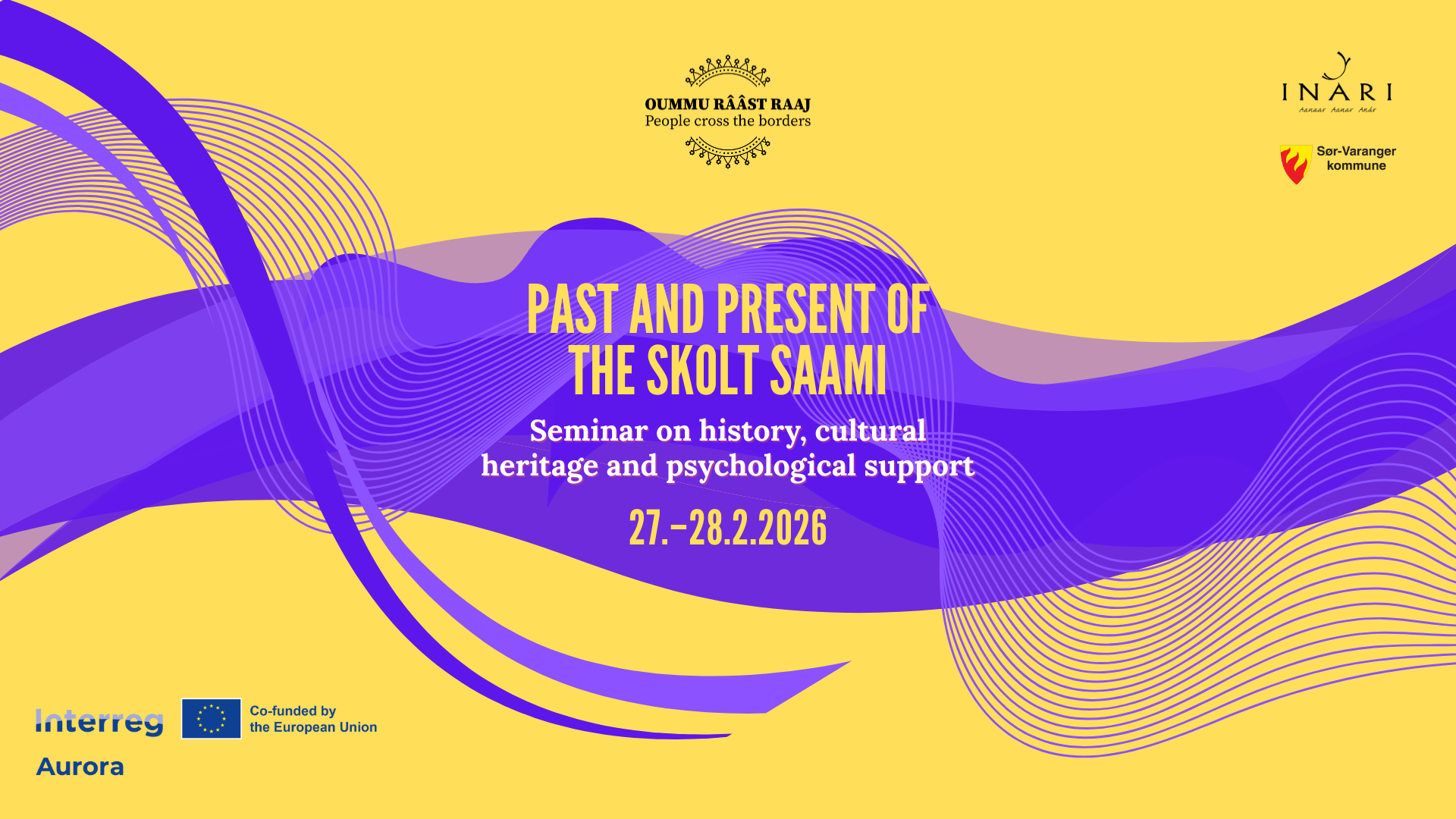
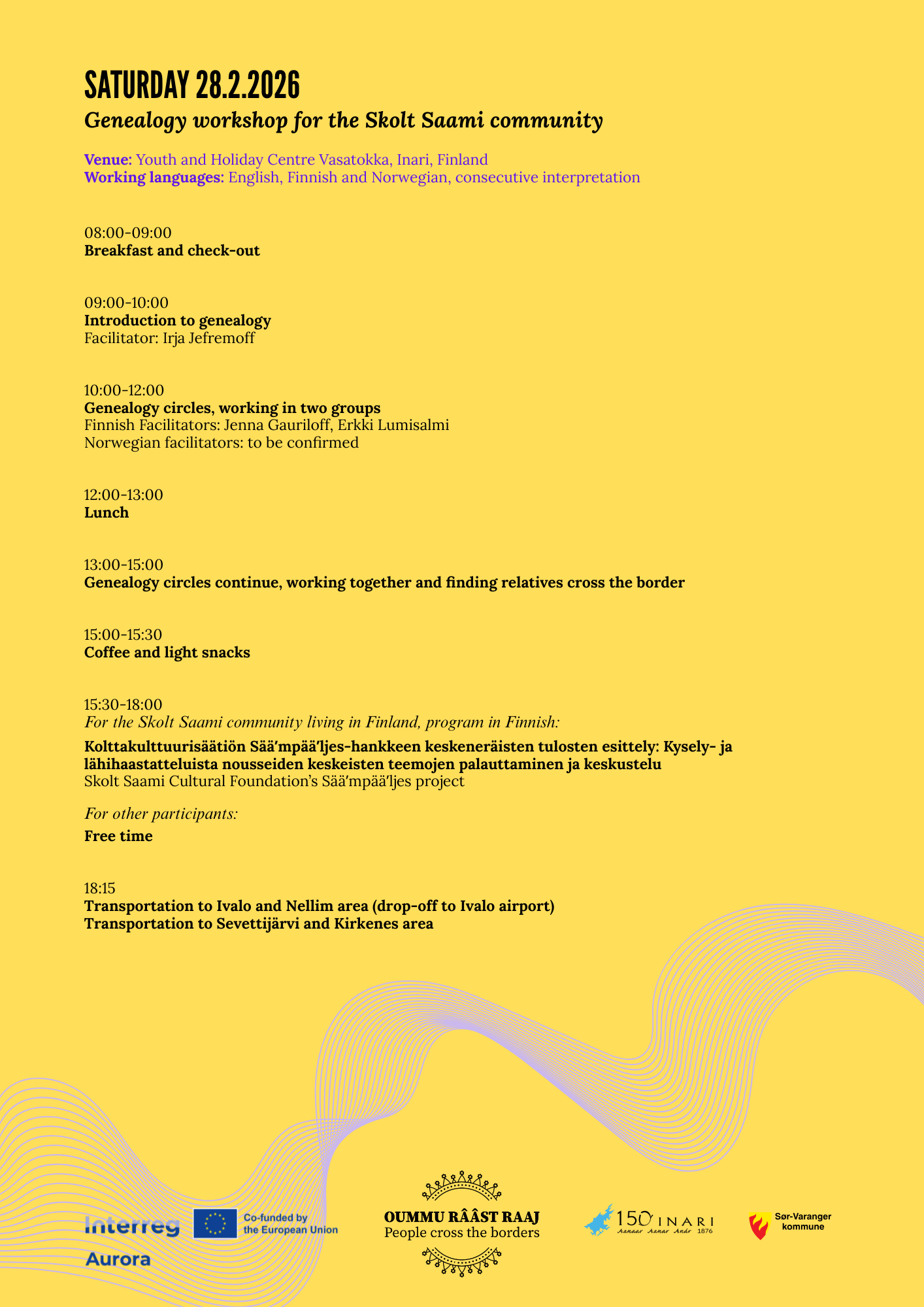
A seminar on the Skolt Saami history, cultural heritage and psychological support was held in Inari, Finland on February 27–28, 2026. On Friday we provided an open-to-all, interesting and diverse spread of lectures and panel discussions by experts in their fields. The working language was English with simultaneous interpretation to Finnish and Norwegian. The seminar continued at Youth and Holiday Centre Vasatokka on Saturday with a practical workshop intended for the Skolt Saami community members, where participants couldn delve into their own background and history through genealogy.
Livestream recordings
The friday's seminar was livestreamed and the recordings can be found in English and interpretated into Finnish and Norwegian from Inari Municipality's YouTube channel: Past and Present of the Skolt Saami - YouTube
Below you can see the seminar program and more information on the lectures and presentators in English. A simplified schedule of the seminar can be downloaded below in Finnish, Norwegian and English.
Seminar program
Download the full program as a PDF here.
Download the simplified schedule of the seminar in Finnish, Norwegian and English here.
Lecture topics
12:45‒14:00 Making and Crossing Borders in Finnish Petsamo
By Petsamo: A Finnish Settler Colony -project (KONE foundation)
Making and Crossing Borders in Finnish Petsamo is a colletion of three different lectures that will discuss the many meanings of borders and how to make them — but also cross them. Both physical and mental boundaries have determined people’s possibilities throughout history. Dividing people into different classes has been one attempt to set and make borders. In multicultural Petsamo however, the boundaries were also fluid in many ways and crossing borders was possible for people despite their background.
Exclusion and inclusion of Skolt Saami in Finnish national strategies 1918-1940
Peter Stadius
Professor in Nordic Studies, University of Helsinki
Research Director, CENS
Crossing Borders in the Finnish Literary Representations of Pechenga
Elina Arminen
Senior University Lecturer at University of Eastern Finland
Borders, families and sijds
Sonja Tanhua, PhD
Post doc researchers at Petsamo: A Finnis Settler Colony -project;( Kone Foundation.), University of Helsinki
15:00‒16:00 The Skolt Saami language
Drawing borders, silencing languages: The sociolinguistic history of Skolt Saami societies 1850s‒2020s
In this presentation, I will describe the changes in language skills, education, and language attitudes of the Skolt Saami between the 1850s and 2020s and analyze the reasons for these changes. The Skolt Saami have been a highly multilingual people, and for a long time, they saw multilingualism as a positive value, as it helped individuals to cope in varying situations and contexts. The same ideology was dominant in connection to the value given to schooling and education in general, even though this was only available in majority languages. From World War II, in Norway even before, language attitudes began to change rapidly and the nationalistic ideal of monolingualism started to gain ground. To learn other, larger languages was viewed as more important than knowing Skolt Saami. This was caused by forced assimilation, which was practiced especially in schools from the early twentieth century on, and by negative attitudes of the majority populations, especially peer groups. In Soviet Union this was connected to several forced relocations and, during Stalin’s era, genocide-like mass executions of Saami intelligentsia. Since the late twentieth and early twenty-first century language attitudes have started to change yet again, and an active language revitalization process has started in Finland, and there are similar plans in Norway.
This presentation is based on two published analyses of existing older sources and present-day interviews by Taarna Valtonen and Markus Juutinen published in 2024 and 2025.
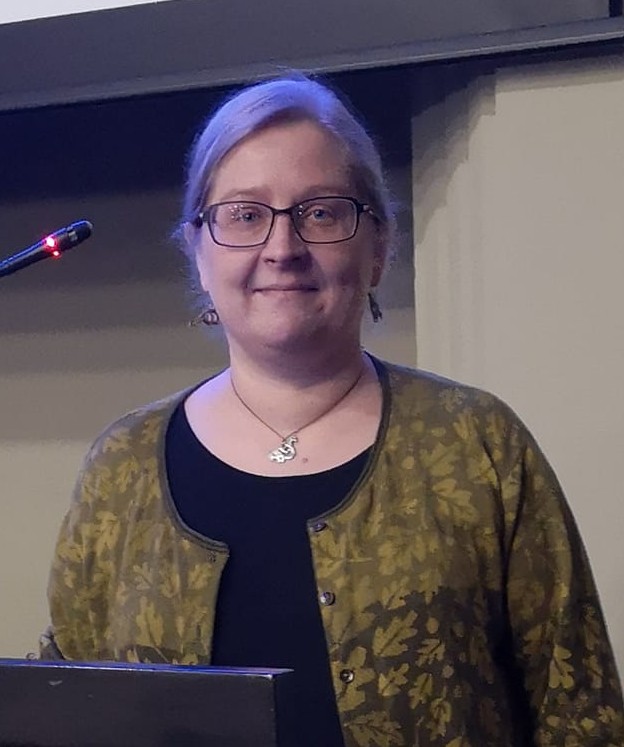
Taarna Valtonen
Senior researcher, University of Turku / Research Council of Finland
Associate Professor (Title of Docent) Giellagas Institute, University of Oulu
Taarna Valtonen, PhD, is Associate Professor (Title of Docent) of Sami language at the Giellagas Institute for Saami Studies at the University of Oulu, currently working as a senior researcher at the University of Turku. She is one of the researchers on the research project Skolt Saami Grammar for the Skolt Saami funded by the Research Council of Finland. Her research interests lie, in general, in the field of multidisciplinary Saami Studies with a focus on linguistics, history, folkloristics, and cultural studies. It is characteristic of her work to offer a wide understanding and historical contextualization of the topic and subjects under study, and she always attempts to interpret the research materials from a Saami point of view.
Skolt Saami dialects
In this presentation, I will present an overall picture of Skolt Saami dialects. At the beginning of 20th century Skolt Saami was spoken in seven sijdd's. Skolt Saami dialects can be into two groups: inland dialects, which where spoken in the sijdds of Suõʹnnʼjel (Suonikylä), Njuõʹttjäuʹrr (Nuortijärvi) and Sââʹrves (Hirvasjärvi), and the coastal dialects, which where spoken in the sijdds of Njauddâm (Neiden), Paččjokk (Paatsjoki, Pasvik), Peäccam (Petsamo) and Mueʹtǩǩ (Muotka). In this presentation I will concentrate on the dialects of Njauddâm, Paččjokk–Peäccam, which is spoken nowadays mainly in Southern Aanar (Inari), as well as on the Suõʹnnʼjel dialect, which is spoken mainly in the Čeʹvetjäuʹrr (Sevettijärvi) region. I focus on the features that distinguish dialects from each other.
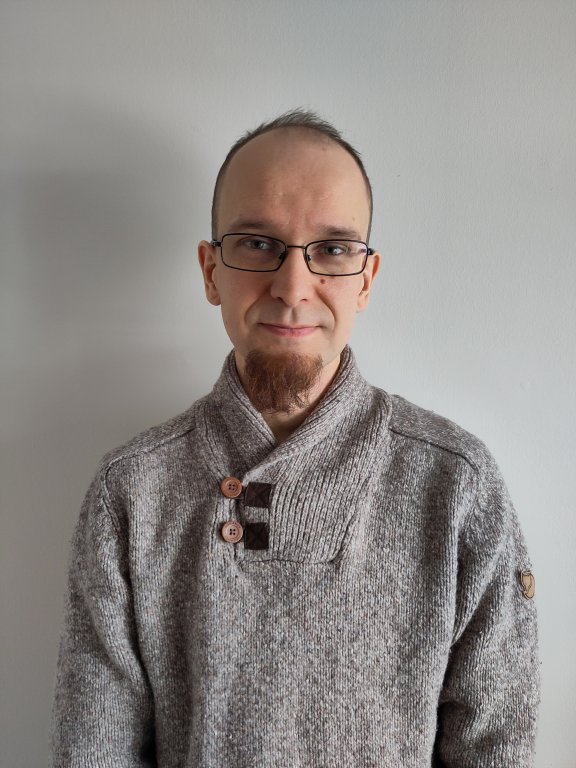
Markus Juutinen, PhD
Markus Juutinen, PhD, is University Lecturer of Skolt Saami at the Giellagas Institute for Saami Studies at the University of Oulu, currently working also as a researcher at the University of Turku. He is one of the researchers on the research project Skolt Saami Grammar for the Skolt Saami funded by the Research Council of Finland. His research interests lie, in the field of Saami Studies with a focus on language contacts language history, sociolinguistics, as well as history and culture of Skolt Saami.
Saturday 28th of February, 2026
More information
Joni Gauriloff,
project manager Inari Municipality, Oummu rââst raaj project
joni.gauriloff@inari.fi
+358 40 5742143
 print page